


Securing the best mortgage options for self-employed buyers in Florida can feel confusing. If you work for yourself, you already know that traditional lenders often ask for detailed proof of income, which may not match how you actually earn. But don’t worry—many successful self-employed Floridians buy homes every year. You just need to know where to look, how to prepare, and what to expect. In this guide, you’ll discover how to choose the right mortgage, what lenders really want, and how to boost your approval odds. Whether you’re a freelancer, small business owner, or gig worker, the path to homeownership is open. Let’s explore the best ways for self-employed buyers in Florida to finance their new home and get the keys in hand.
Why Self-employed Buyers Face Unique Challenges In Florida
Getting a mortgage when you’re self-employed is different from a standard job. Lenders look for stable, verifiable income. However, your tax returns might show less income because of business deductions. In Florida, where the real estate market is competitive and fast-moving, buyers need to be extra prepared.
Common challenges include:
- Proving steady income
- Providing more paperwork than W-2 employees
- Meeting higher credit score standards
- Handling bigger down payments
Still, there are mortgage options designed to help. If you know what lenders want and prepare your documents, your chances of approval are much higher.
Top Mortgage Options For Self-employed Buyers In Florida
Choosing the best mortgage options for self-employed buyers in Florida means understanding what’s available. Here are the most popular and flexible choices.
1. Conventional Loans
Conventional loans are offered by most banks and credit unions. They follow rules set by Fannie Mae and Freddie Mac. If you have good credit and a solid income history, this is a popular choice.
Key points:
- Usually need a 20% down payment, but some lenders accept less with private mortgage insurance (PMI)
- Must show two years of tax returns
- Lenders may average your income over two years
Example:
If you earned $80,000 one year and $100,000 the next, lenders average to $90,000. If you had a slow year, it can affect how much you can borrow.
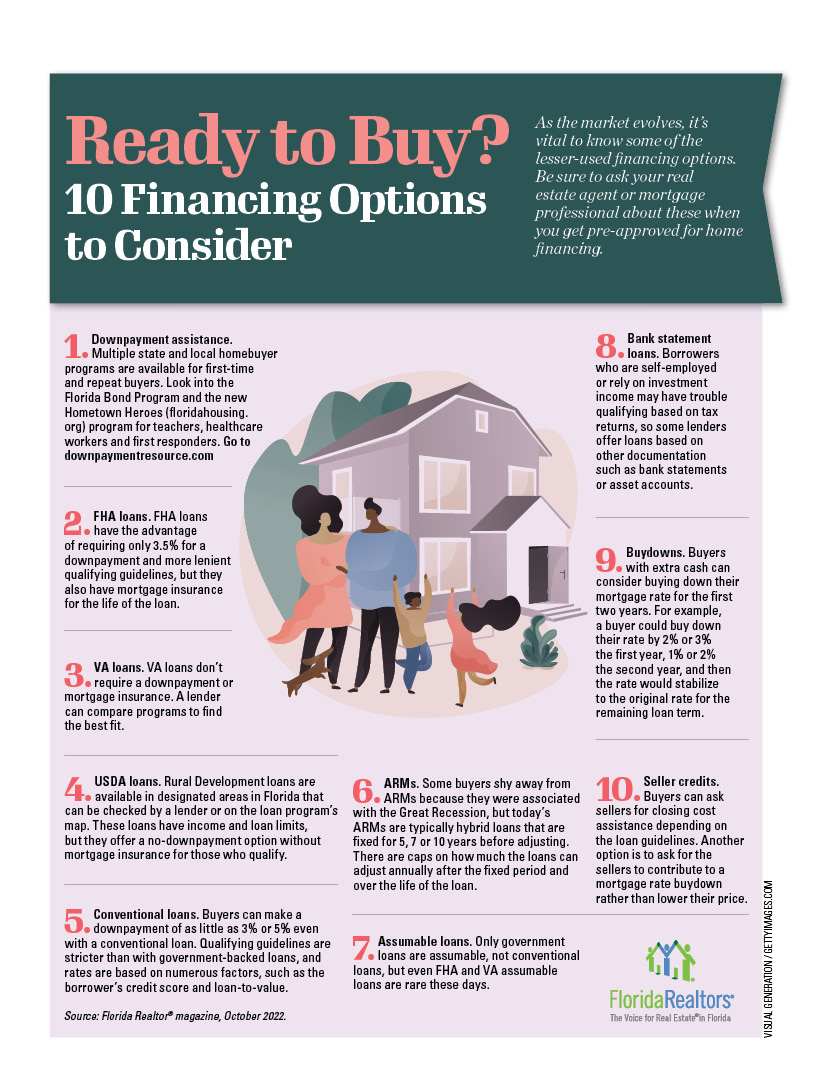
2. Bank Statement Loans
Bank statement loans are made for self-employed people who don’t have strong tax returns but can show regular bank deposits.
Features:
- Use 12–24 months of personal or business bank statements
- No need for tax returns in most cases
- Down payment usually starts at 10–20%
- Credit score requirements vary, but 620+ is common
Example:
A graphic designer with steady business income but many tax deductions can use bank statements to show real cash flow.
3. Fha Loans
FHA loans are backed by the Federal Housing Administration. They help buyers with lower credit or smaller down payments.
Benefits:
- Down payments as low as 3.5%
- Accepts lower credit scores (580+)
- Must show two years of steady income
Note:
FHA loans still require proof of income, but they may be more flexible about your income sources.
4. Non-qualified Mortgage (non-qm) Loans
Non-QM loans are designed for people who don’t fit traditional lending standards. They can use alternative documents to prove income.
Key features:
- Accepts bank statements, 1099s, profit and loss statements
- Down payments are usually higher (10–20%)
- Interest rates may be slightly above conventional loans
Example:
A real estate agent with big swings in income can use a Non-QM loan to show their average earnings.
5. Asset-based Mortgages
Asset-based loans let you qualify based on your assets instead of income.
How they work:
- Lender looks at savings, investments, or retirement funds
- Good for buyers with significant savings but low monthly income
- Great for retirees, investors, or business owners selling a company
Tip:
Not every lender offers asset-based loans, so ask upfront.
6. Jumbo Loans
Jumbo loans are for homes above the conforming loan limit (over $726,200 in most of Florida for 2024).
Important details:
- Higher loan amounts, often used for luxury or beachfront homes
- Require strong credit and larger down payments (20%+)
- Need full income and asset verification
7. Portfolio Loans
Portfolio loans are kept by the bank, not sold to investors. This gives lenders more flexibility on their rules.
Advantages:
- Custom guidelines for self-employed buyers
- Can be a solution if you don’t qualify elsewhere
- Often used by local banks or credit unions
Credit: trussfinancialgroup.com
Comparing Mortgage Options For Self-employed Buyers
It’s hard to know which loan is best without seeing them side by side. Here’s a comparison to help you decide:
| Loan Type | Down Payment | Credit Score | Income Proof |
|---|---|---|---|
| Conventional | 5–20% | 620+ | Tax returns |
| Bank Statement | 10–20% | 620+ | Bank statements |
| FHA | 3.5%+ | 580+ | Tax returns |
| Non-QM | 10–20% | Varies | Flexible docs |
| Asset-Based | 20%+ | Varies | Assets |
| Jumbo | 20%+ | 700+ | Full docs |
| Portfolio | 5–20%+ | Flexible | Flexible |
How To Qualify For The Best Mortgage As A Self-employed Buyer
Knowing which loan is best is just one part. You must also show lenders you are a safe bet. Here’s how:
Prepare Your Documents
You’ll need to show:
- At least two years of personal and business tax returns (unless using bank statement or Non-QM loans)
- Profit and loss statements for your business
- Recent bank statements (personal and/or business)
- List of debts and monthly expenses
If your income goes up and down, explain why. Write a short letter to the lender about your business and industry. Lenders appreciate clear stories.
Boost Your Credit Score
A higher credit score means better rates and more choices. Check your score before applying. Pay off debts, avoid new credit, and fix errors on your credit report.
Florida Fact:
The average credit score in Florida is 707 (Experian, 2023). Aim for 720 or higher for the best rates.
Save For A Bigger Down Payment
A larger down payment shows lenders you are serious and lowers your risk. It can also help you qualify if your income is hard to verify.
- 20% down is ideal for conventional and jumbo loans
- 10%–15% is common for bank statement and Non-QM loans
Keep Business And Personal Finances Separate
Open a separate business bank account if you don’t have one. This makes it much easier to show your income and expenses. Lenders like clean records.
Reduce Business Deductions Before Applying
Many self-employed people write off lots of business expenses to lower taxes. This can hurt your loan application because it shows less income. For one or two years before buying, consider reducing deductions to increase your qualifying income.
Work With A Mortgage Broker Experienced With Self-employed Buyers
Not every lender understands the self-employed life. A good broker knows which banks offer the most flexible programs and can guide you through the process. They can save you time and stress.
Key Mistakes Self-employed Buyers Make (and How To Avoid Them)
Many buyers lose out because of small errors. Here are mistakes to avoid:
- Mixing business and personal funds – Always keep accounts separate.
- Not planning ahead – Start preparing your documents at least six months before applying.
- Over-deducting on taxes – This can lower your qualifying income.
- Waiting too long to boost credit – Improving your score can take months.
- Choosing the wrong lender – Not all lenders understand self-employment income.
If you avoid these pitfalls, you’ll have a much smoother journey.
Florida-specific Tips For Self-employed Mortgage Seekers
Florida’s market is unique. Here’s how to succeed:
- Home prices vary widely by region. Miami and Naples are much pricier than smaller towns.
- Hurricane insurance is required in many places and can add to your costs.
- Condos and HOAs have extra rules. If you’re buying a condo, check the building’s finances and insurance status.
- Seasonal income is common in Florida. Lenders may be flexible if you work in tourism, construction, or agriculture. Explain your income cycle clearly.

Credit: www.makefloridayourhome.com
Mortgage Rates And Terms For Self-employed Buyers
Rates for self-employed buyers are often a bit higher than for W-2 employees. Here’s a quick look at what to expect:
| Loan Type | Typical Rate (2024) | Term Lengths |
|---|---|---|
| Conventional | 6.2%–7.0% | 15, 20, 30 years |
| Bank Statement | 7.0%–8.5% | 15, 30 years |
| FHA | 6.0%–7.2% | 15, 30 years |
| Non-QM | 7.5%–9.0% | 15, 30 years |
| Jumbo | 7.0%–8.0% | 15, 30 years |
Rates can change daily, so check with lenders for the latest numbers.
Two Non-obvious Insights For Self-employed Buyers
- Lenders care about trends, not just totals. If your income is rising each year, highlight this to your lender. If it’s dropping, explain the reason (such as pandemic effects or temporary business changes).
- You can use business assets to strengthen your file. Showing healthy business savings or investments can help you qualify, even if your income is hard to prove.
Credit: www.floridarealtors.org
Call To Action: Get Expert Help Today
Buying a home as a self-employed professional in Florida is possible with the right strategy. Start organizing your documents now and reach out for advice. If you want expert help finding the best mortgage options for self-employed buyers in Florida, contact us at info@enriquebello.com or call +1 (706) 844-3723. Unlock your dream home with less stress and more confidence!
For more information on self-employed mortgages, visit the Consumer Financial Protection Bureau.
Frequently Asked Questions
What Documents Do Self-employed Buyers Need For A Mortgage In Florida?
You usually need two years of tax returns, recent bank statements, a profit and loss statement, and proof of business ownership. Some loans may let you use just bank statements instead.
Can I Qualify For A Mortgage If My Income Changes Every Month?
Yes, but lenders will often average your income over the past 12–24 months. If your income is seasonal or varies, write a letter to explain the changes.
Is It Harder To Get A Mortgage If I Use A Lot Of Tax Deductions?
It can be, because deductions lower your reported income. Consider limiting deductions before applying, or choose a loan that looks at bank statements instead of tax returns.
What Type Of Mortgage Is Best For Self-employed Buyers In Florida?
Many choose bank statement loans or Non-QM loans because they are flexible with income proof. Conventional and FHA loans are good if your tax returns show strong income.
How Can I Improve My Chances Of Approval As A Self-employed Buyer?
Keep business and personal finances separate, boost your credit score, save for a bigger down payment, and work with a lender experienced in self-employed mortgages.
Ready to get started? Call +1 (706) 844-3723 or email info@enriquebello. com for personal help with your mortgage journey!